I have written book reviews in the past in bits and pieces. However, it has been a long time wish to make a comprehensive list of the best investing books that I have read. Such a list goes beyond the typical finance focus and takes a multidisciplinary approach, which is something investment legend Charlie Munger had been advocating for. Hence, in this long (really really long!) piece, not only you will find the usual topics such as valuation and accounting, but also life advice, culture, philosophy etc. The list is however only limited to books that I have personally read and so don’t be disappointed if one of your favorites did not make it. I know that some great books are missing and once I have read those I will include them also.
Introduction to startup investing – a reading list

I was late to the startup game. Ever since I graduated in 2008, my world revolved around investing in public equities and I spent most of my time learning how to be a better investor in the public markets.
A few years back when the startup movement just started in Bangladesh,
Read moreHow I have changed my reading habits over time
As a lot of my readers know, I love reading books. I have also mentioned previously that, over the years two things happened to my reading list.
- First, I read less of finance theory and more biographies, interviews, practical investing methods etc.
- Secondly, I broadened out into many other subjects like history, communication, journalism, psychology etc instead of keeping myself solely fixed on finance/investing.
Lately, I have made another change. I am now identifying topics that interest me and instead of reading one or two books on the topic, I am reading four or five back to back.
This sort of started early last year when I wanted to learn about “Quantitative investment strategies”. I think I ended up reading at least 6 books related to such strategies. This year I started on “entrepreneurship and startups” and again read a bunch of books and then moved on to “digital marketing/growth hacking”.
I think this approach is pretty cool . By reading multiple books (also reading 2 to 3 books on the same topic simultaneously) I am able to quickly judge if a book is not worth finishing. Also I can connect dots between the topics much better and come up with my own interconnected theories on the subject by combining elements from multiple sources.
To see what books I read you can check out my Goodreads profile.
Investing in early stage companies; mental challenges for a public market investor

Source: unsplash.com
I have been involved with stock markets for more than 10 years. Over the years, I learned that a lot of commonly held beliefs can be misleading. For example, one of the first things finance students learn is ‘not to put all eggs in one basket’. Yet, the best asset managers of the world generally prefer to do concentrated investing. The logic in this case is that risk does not have to be minimized by pure diversification (which will tend to reduce return also), but rather by studying the business very well and buying with a margin of safety. Also, why would someone buy the 40th best investment idea when he could concentrate in the top 15 to 20 stocks.
The above is just one example of the type of lessons I learned which served me well in terms of public market investing. The problems appeared when I decided that its time I become an angel investor also. I quickly realized that some of these need to be ‘unlearned’ if I wanted to succeed. Below I am going to list down a few of these.
- Diversification is not just recommended but absolutely mandatory: In early stage investing, there is no way to know in advance which company will succeed and which company will fail. No amount of research can predict where revenues will be 3 years from now. As a result, concentrated investing in early stage companies is a recipe for disaster. Most veteran angel investors recommend that one should build a portfolio of 30 to 40 companies.
- Valuation is not the most important factor: My biggest challenge even today remains getting comfortable with valuation. In public market investing, return performance depends on the ability to buy a stock below its ‘fair value’. Thus valuation is pretty much everything for a value investor. For startups, what matters is betting on the right companies. If you have invested in a company growing revenues 15% per week, it does not matter whether you invested at a valuation of BDT20mn or BDT30mn.
- Qualitative factors over quantitative: While qualitative factors such as corporate governance plays an important role in public market investing its much more pronounced for startups. For early stage companies, there is often no track record do be able to do any numerical analysis. We really have to judge how good an entrepreneur will be at execution based on his or her personality or communication ability.
- Friendly activism can help improve success rates: As a public market investor, we seldom try to influence the management. Although there are examples of activism in developed world, its still pretty rare in this part of the world. For startups however, the ability to connect the founder with clients, quality talent, suppliers, media etc can all have profound impact on its chances of survival. In fact, the founders will probably select investors on their ability to make these introductions.
These are some of the most obvious differences I have found between stock market investing and startup investing. There are probably more which only time will teach me as I continue on this journey.
The start of EDGE Bangladesh mutual fund and our research services
In my last post written yesterday, I discussed about the decision to quit my job to start two companies. Now I will discuss the two businesses that we have started, EDGE AMC Limited and EDGE Research & Consulting Limited. We decided on the name EDGE as it is a synonym for competitive advantage and we certainly believe that we had a few such advantages. But it also suggests being at the forefront of something (pushing boundaries and trying new things). More importantly, it was the only name all of us could agree upon.

Source: www.pexels.com
EDGE AMC LIMITED
We always planned of starting an Asset Management Company. Our long experience in capital markets and academic knowledge made us suited for such a business. The size of the Asset Management industry in Bangladesh is also extremely small which we believed had to increase at some point.
Risk, entrepreneurship and a post after a year
The last post I made on this blog was on February 2018 which is almost a year ago. The longest stretch of time without a single post on this blog. I wish I could say that I was too busy to write, but honestly speaking that is a pretty weak excuse. Therefore, the official answer is that I took a break.

Source: pexels.com
2018 was a very important year for me and brought major changes. The seeds of this change were actually planted in mid 2017 when I had decided to quit my job and pursue entrepreneurship. From January 2018, my relationship with my former employer was fullyover and I could concentrate on own business. When I look back there wasn’t a single reason to quit my job but rather a combination of many factors.
Firstly, I was perhaps a bit bored and felt that I wasn’t learning as much as before. Although my businesses (I will talk about them in later posts) are very related to investing, as a business owner you get to put on many hats as a salesperson (selling your product to clients), human resource manager (hiring and motivating staff), IT guy (dealing with software and hardware). To keep your business alive you are forced to learn these new things and develop yourself.
The second thing was the optionality of a big payoff. Starting a new business is risky. There is also a big opportunity cost in terms of the lost monthly salaries. Yet, if the business clicks the financial payoff could be extremely large. This kind of risk can be taken only when a person has enough savings to fall back on if the venture fails. Fortunately, by saving since my college days and living frugally I had that comfort. Worse case, I could always come back to job life.
The third and perhaps the biggest reason for starting the business was my co-founders. Most of my career I had worked alone in Bangladesh, working for companies based in New York or London. I missed working in a team environment. I am lucky to have two exceptional people as my partners. In my 10 years of career, I have the highest degree of job satisfaction at the moment.
I will end the post here. In later posts I would describe the two businesses we have started, what some of the big learning has been in the last one year and finally how my reading list has evolved ever since I have started the two companies.
The chemistry of investing
Q: What happens when you add a risk free security with the efficient frontier?
A: You get the capital market line (CML). Theoretically you can choose the right mix of risky and risk free assets to create the highest return portfolios for each levels of risk.
Practically its a different issue altogether. In my 9 plus years of investing career I have not been able to figure out what to exactly do with this piece of information. Maybe we just move on.
Q. What happens when you diversify your stock portfolio?
A: You diversify away company specific risks and thus you are left with market risk. This is a nifty bit of knowledge because its pretty usable for everyone. It also goes well with the wise old statement of not putting all your eggs in one basket.
The benefits of diversification however start to come down after you own about 10 different stocks (this number can be slightly debatable). The value investing community (with some exceptions like Walter Schloss who owned a diversified pool of deep value stocks) generally believe owning concentrated portfolios that have a margin of safety is a better strategy. What is the point of owning your 50th best idea if you could buy your top 10-20?
Q. What happens when you combine other things?
Adding special situation investing like merger arbitrage or closed end mutual fund redemption to a portfolio of stocks can reduce portfolio beta as the outcome on such special situations are often not dependent on market direction. Adding a bond portfolio to stock portfolio can also reduce portfolio can also reduce portfolio risk (these two asset classes have often been negatively correlated) while maintaining most of the return. Adding a momentum strategy (buying stocks that have outperformed over a 6 to 12 month period) to a portfolio of deep value (low EV/EBITDA) stocks can ensure you still have a job after a prolonged period of under-performance by either of the strategies. For example being a value investor around the time of the Dot Com bubble has clearly sucked.
The above examples are clearly examples of good things happening. But just as combinations can create good they can also create bad. A pool of toxic mortgages will still remain toxic. And as much as Michael Milken claims that a portfolio of junk bonds aren’t as risky as people perceive them to be, he is quite wrong.
Q. No good story on investing is good without leverage, right?
Leverage is a double edged sword. It magnifies return and magnifies risk. Men always thought it could tame this wild beast called leverage but each time too much debt built up in the system it ended up in some sort of fiasco.
Yet this is where things start getting interesting. Let us look at Warren Buffett’s method of adding leverage. He used the float on insurance premiums to add leverage to portfolio. The advantage of this method is that there is no interest to be paid on the debt. It does however magnify risk and return just like conventional debt. But because Buffett adds leverage he does the opposite thing while picking stocks. He loves buying companies with extremely predictable cash flows with very wide moats. So predictable companies + natural leverage = high returns.
By chance I stumbled upon other examples of people who use this exact approach but in a very different context. Take the fabled quant hedge fund Long Term Capital Management. It put on mean reversion trades which had low chance of going wrong but magnified the measly returns with a mountain of debt. We all know how that story ended.
Quant shops have since then improvised. Although a secretive bunch some of them still use statistical or convertible arbitrage trades which lower risk and return to some extent. The low returns are then magnified using leverage. The difference this time is better execution and probably lower levels of leverage. It also helps quants to understand that models can never really mimic real-life and adds a degree of humility.
So leverage is like fire. If you are not careful you will be burned. Its not for everyone but often it is the people least able to understand it that sometimes tend to take the highest risk.
Interest rate, stock markets and other issues in Bangladesh
Tracking interest rates in Bangladesh is no easy task!
Banking sector developments have dominated newspaper reports for the last few years. Although non-performing loan formation took the spotlight for a long period, lately soaring rates on fixed deposits and tight liquidity conditions also came under attention. Much has been written on why the interest rate cycle has turned so sharply and so I move to a slightly different territory.
My interest however in on the public data available on interest rates. Generally we can follow a number of the indicators from the central bank website. One is the call money rate, the rate at which one bank lends to another. A quick glance at the rates will show that despite all the hue and cry about liquidity crisis the call money rate has barely bulged. This has happened because there seems to be a verbal guidance from the central bank on what the call money rate should be. This obviously makes the call money market less liquid and prevents it from being an indicator we can use to gauge interest rate conditions.
The second option is to look at yields on government bonds. There also we have a problem as the government has ceased to borrow from the bond market for more than 2 years and instead has been exclusively relying on National Savings Certificates. This lack of demand from the government depresses bond yields and prevents it from showing true liquidity scenario. The 10 year government bond yield is of particular interest to equity analysts because the Capital Asset Pricing Model uses it to form Cost of Equity in valuation models. The 10 year government bond yield in the January auction was 7.39% which means it has barely moved from the lows reached. Using this rate in valuation models will inevitably lead to asset overvaluation.
In the chart below we can clearly see that the government bond yield line is not smooth. Auctions did not take place in those periods.
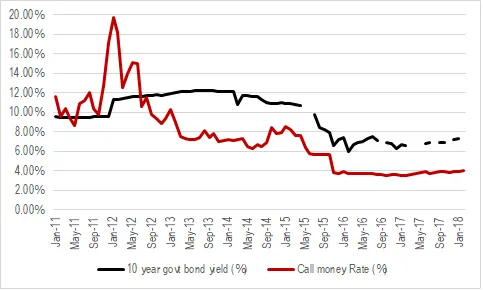
A third option to track interest rate is looking at weighted average deposit rates. This data comes with a bit of lag and because the rate is an average not just fixed deposits but also current and saving deposits it will not capture the size of the move in interest rates.
Regardless of these data challenges it is very clear that interest rates in reality has gone up. Banks which not too long ago offered as low as 5/6% on fixed deposit have raised that to 9/10%. A 400bps move in a matter of months is a very steep move. And the failure to notice this will lead to missed opportunities and losses. For equity analysts not revising up their cost of equity assumptions will mistakenly feel that equities maybe undervalued. Depositors might also be unaware that rates have been increasing and can lock in lower fixed deposit rates for long periods.
Interest rate and stock prices. What does the theory say?
In a discounted cash flow (DCF) framework keeping all other things constant a higher interest rate in the economy will lead to lower values. The transmission mechanism is generally via the risk free rate (aka 10 year government bond yield) which goes up with interest rates and we end up with a higher cost of equity. Discounting future cash flows with higher discount rates will lead to lower values than the past.
There is a common misconception about companies which have a lot of net cash balance in their balance sheet. We can take the example of Square Pharmaceuticals where cash and marketable securities make up 38% of assets (there is barely any debt either). From an accounting perspective, higher interest rates would result in higher interest income on their cash balances and higher earnings. However if we use the DCF framework then the impact of higher interest rates is a net negative.
Value = Net Cash + PV of future cash flows
Where
Net Cash = Cash – Debt
The net cash on balance sheet is today’s value and is not sensitive to interest rates. The Present value of future cash flows on the other hand reduces leading to a lower value. What is however true is that companies with 0 net cash balances are more sensitive to interest rate hikes and will suffer more relatively. So a company like Square with lots of cash in hand will be less sensitive than companies burdened with a lot of debt like ACI.
What needs to be remembered is that the DCF method only mentions what the ‘intrinsic value’ of a company is. It does not say that price at any given time equals intrinsic value. Understanding the distinction can help us interpret the findings from the next segment.
What if we don’t keep all other things constant?
So far in our discussion we only changed interest rates but made no reference to cash flows. Small changes in interest rates may have no effect on the real economy. But large changes can lead to reduction in consumption as aggregate demand comes down. So some businesses might feel a double whammy as future cash flows could decline and the discount rate used on those flows could go up.
We also need to be clear about what is causing interest rates to move up. An increase in long-term government bond yield could happen because of expectations of faster economic growth (this increases the real risk free rate). In this case however, we are actually revising up our estimates of future cash flow but using a higher discount rate. The net result could be either positive or negative.
Does real world data confirm the theory?
Reality is always a bit more complex and messier than theory suggests. By and large periods of higher interest rates result in lower stock prices (and the theory is proved). However, there are periods in history when higher interest rates coincides with increasing stock prices. In the chart below in the period between 2000 and 2008 higher stock market and higher interest rates happened at the same time for the US market.
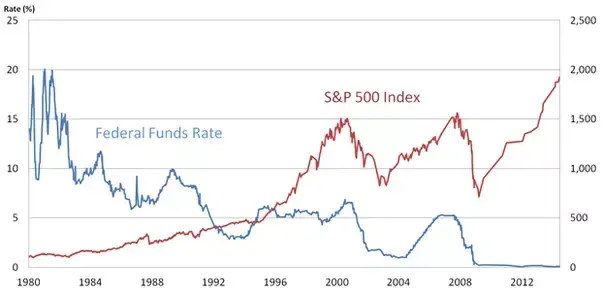
We can try to interpret this data with the benefit of hindsight. The period before 2000 coincided with the Dot Com bubble which led to an overvalued stock market. Even though interest rates came down the stock prices were probably still overvalued. There could have been an overreaction even which is why in the next period stocks actually rallied even though interest rates were increasing.
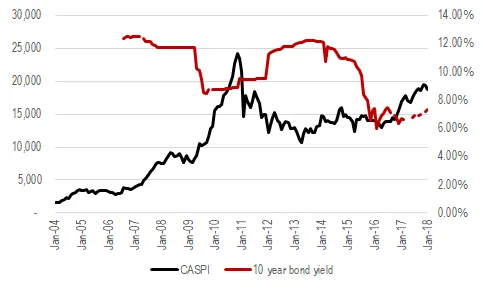
I have similarly tried to replicate using data from Bangladesh market. My choice of index was the Chittagong All Share Price Index (CASPI) which has longer history than the DGEN. With the limited history available it can be concluded that the relationship between interest rates and stocks held for most of the period. The drop in bond yields from 2007-09 coincided with one of the strongest periods for the market. While interest rates started going up from early 2010 the impact on the index only came towards the latter end (with a lag) but held on till mid 2013. Since then yields started coming down and stock market regained much of what was lost.
This proves an important point. The relationship between interest rates and stock prices hold when prices are in equilibrium (price = intrinsic value) or higher than intrinsic value during a period of rising interest rates. If stocks were undervalued to begin with then higher rates may not lead to further stock price declines. In investing world we refer to this as “how much of the risk is already priced in today”.
Final thoughts
Let us have a quick recap of what we have discussed so far.
1. Despite no clear sign from the popular data on interest rate, interest rates in the financial sector have moved up a lot.
2. According to finance theory, higher interest rates should lead to reduction in equity values. Stocks with net cash will also be negatively affected but may perform better than those with lot of debt.
3. Cause of higher rates are also important. Higher economic growth can lead to higher long-term bond yields. This may have a net positive effect as we revise our cash flow projections upwards.
4. In practice there are periods of anomalies where higher interest rates coincided with higher stock prices.
The real effect of interest rates on stocks therefore depends on prevailing stock valuations. If rate hikes are happening when stock valuations (computed using P/E or P/B) are already very high then we will inevitably see stock prices decline. If they aren’t then its harder to predict how prices will end up reacting.
Source: Data for the first chart is from Bangladesh Bank. The bond yields only show yields on new auctions. The data from the second chart sourced from a Quora question on the same topic.
Role of cash in a stock portfolio
I have agonized over the role of cash in stock portfolios for long. Often I felt that I should have some cash at all situations because market throws some very attractive opportunities from time to time. Other times I felt that by not remaining fully invested in the stock market I am trying to time the market which is impossible. Generally I have jumped around from one school of thought to another. Before I go into my latest thoughts on cash let me share what two popular investors practice.
Reconciling cash flows and net profit
One of the first thing we learn about investing is the price to earnings ratio. Analysts spend a great deal of time trying to forecast earnings and whether companies meet analyst expectations of earnings tend to move stock prices in the short-term. What is however surprising is that valuation models of companies use cash flows and not earnings. Thus, its cash flows and not earnings that determine the value of companies.
Undervalued stock vs undervalued product
By reading about many investors I have realized that looking at an investment case from different angles and perspectives unearth insights which can be very valuable. For example, in a simple DCF framework we value a company only based on its long term cash flows. However, the assets of the company could be used for something totally different and unrelated which can create more value.
There was a story I read about a chain restaurant which was struggling only to be eventually taken over by a smart guy. He sold some of the locations and rented out some other as office space etc. The assets therefore were acquired by the guy who could bring out the maximum value in them. I came across an article in the blog Basehitinvesting which to me was a very interesting way of looking at a company. Instead of trying to find undervalued companies we could try to identify undervalued products and back calculate to see if the company looks undervalued if pricing of the product is maximized.